Our Approach
To realize our vision of a Massachusetts where all residents have the highest possible quality of life, we are guided by the following principles:
- The Social Determinants of Health account for significant variation in health outcomes
- Policies, systems, and social and physical environments are historically based in structural and institutional racism and other forms of oppression
- Structural and institutional racism and other forms of oppression need to be understood and disrupted to eliminate inequities in population health outcomes and the Social Determinants of Health

Addressing the root causes of health inequities so all Massachusetts residents can thrive.
Leading with Race and Racism
The Funds recognizes that people of color in Massachusetts have historically and consistently had less opportunity to lead a healthy life. We also recognize that the root causes of health, including racism, poverty, ageism, and structural and institutional barriers, can create barriers to health for all types of populations. As a result, the Funds wants communities to lead with race and racism, explicitly but not exclusively.
Funding Streams
PSE change approaches are different from direct service or programmatic approaches. PSE change approaches make long-lasting changes within communities to make healthy choices practical and available to all residents. This funding stream supports organizations, coalitions, and municipalities in broadly addressing Social Determinants of Health using a PSE change approach.
- Policy change approaches include the passing or changing of laws, also known as legislation, as well as ordinances, resolutions, mandates, regulations, or rules
- Systems change approaches create fundamental shifts in how problems are solved and how resources and services get distributed
- Environmental change approaches involve the economic, social, or physical surroundings or contexts that affect health outcomes
Learn more about how to apply policy, systems, and environmental change approaches to your own work.
The Healthy Aging funding stream contributes to equitable systems across sectors that affect community-level physical environments and social and economic conditions, ultimately leading to a better quality of life and improved health outcomes for older adults as they age in Massachusetts. The Healthy Aging Fund uses the WHO and AARP’s domains of livability to create more age-friendly communities:
- Transportation
- Housing
- Social participation
- Respect & social inclusion
- Work & civic engagement
- Communication & information
- Community & health services
- Outdoor spaces & buildings
A Community Health Improvement Plan (or CHIP) is a long-term effort to improve the health of a community. The CHIP is based on the results of a community health assessment (CHA), which studies the health-related needs and strengths of a community. CHIPs aim to respond to CHA results, bring together resources and stakeholders, and create a shared framework for community health. CHIPs coordinate strategies between different sectors and stakeholders. These include health care systems and hospitals, health departments, local government, community-based organizations, businesses, and residents.
The Massachusetts Community Health and Healthy Aging Funds supports the development and/or implementation of local and/or regional community health improvement planning processes.
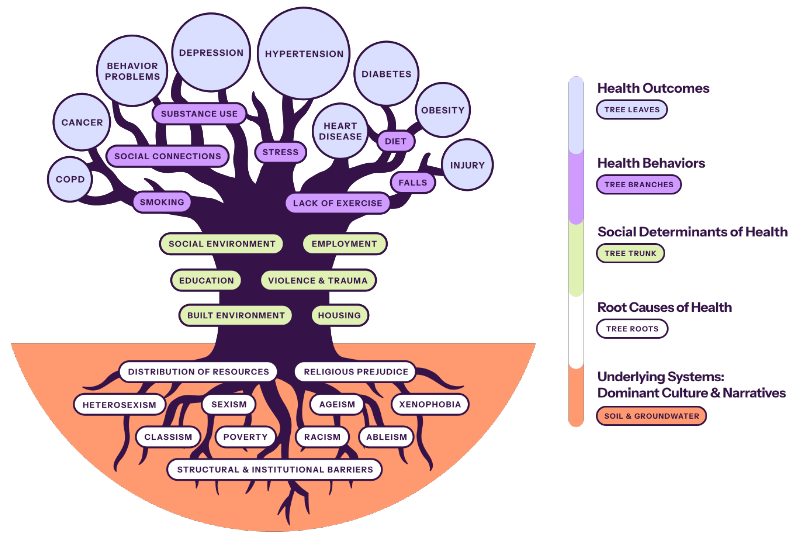
The Health Tree: Connecting Health Outcomes to Root Causes
The Funds’ strategy is based on a model that connects health outcomes to the root causes of health inequities. Awardees focus their initiatives on the root causes of health and Social Determinants of Health to create a sustainable impact on health outcomes. The tree graphic shows the relationship between health outcomes and the root causes of health.